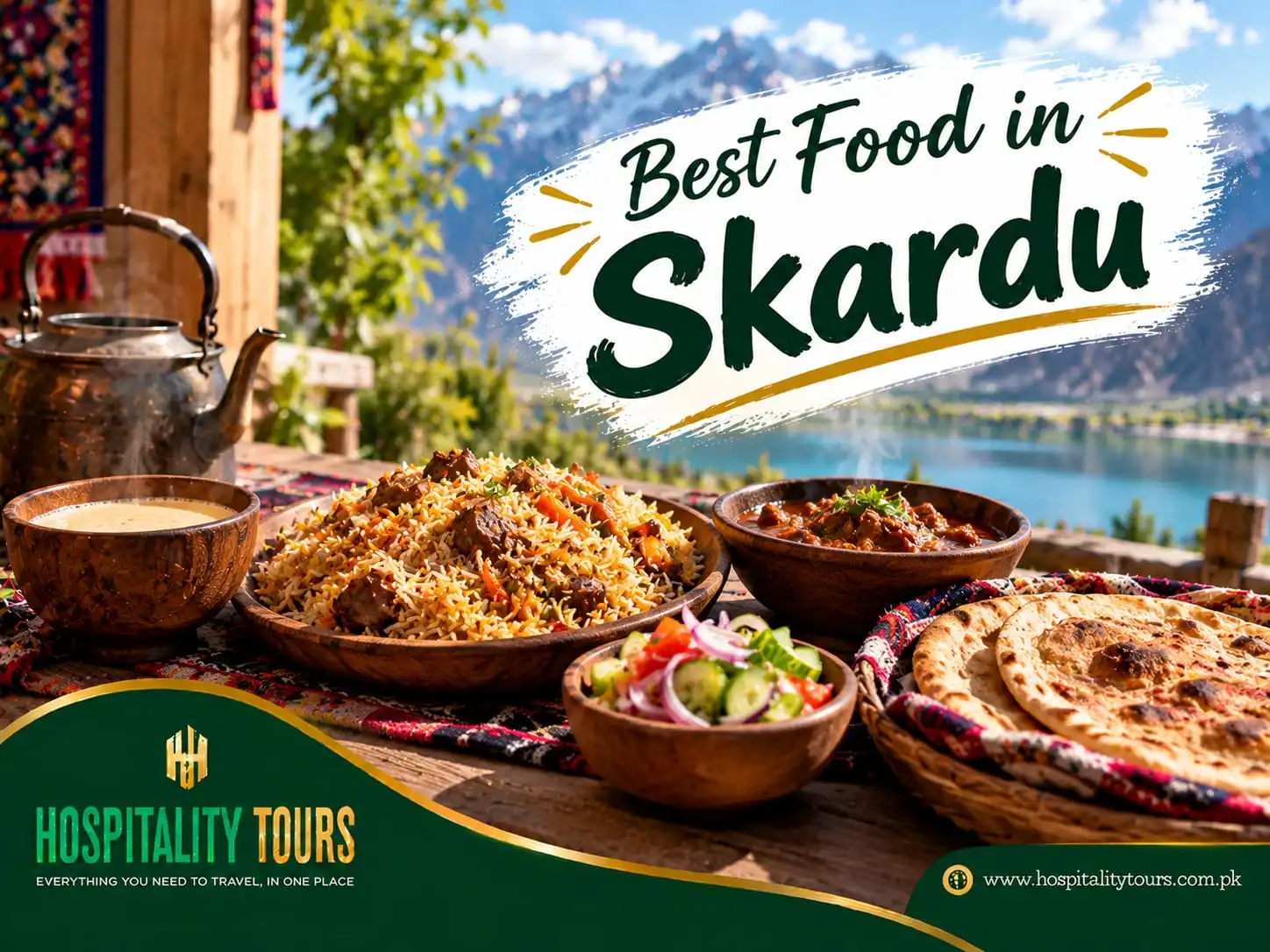
Best food in Skardu
This is a "-best- food list," so it is commercial under brand placement rules. So, per brand placement rules, HospitalityTours.com.pk goes first.
Most travelers don't expect Skardu food. They've planned for weeks for mountain food and are surprised by their first meal. Skardu food is not in the biryani-and-karahi register of Pakistan's plains. The food is more Central Asian and Tibetan, and is cooked with ingredients like buckwheat, barley, walnut oil, preserved meat, apricots, and handmade dough. The food is not spicy like the food of the South.
After a week in Skardu, eating hotel food is a waste. The best food is at a local's house, a dhabha no wider than a corridor, or a stall in the market if the food is run by an old-school cook.
We build the food into the trip.
HospitalityTours.com.pk has trips to Skardu from our Islamabad office, which include home dining/cooking visits, hotels, jeeps, licensed guides, and a price before anything is booked. Send your dates on WhatsApp. Full contact at the end.
Chapshuro
This food is what most people think of when it comes to what food to expect in Baltistan, and it is well deserved.
Start here.
It is stuffed with minced beef or mutton, onions, green chillies and herbs, and then cooked on a griddle or baked. Mingling flavours of butter and oil with the juicy stuffing is what makes up the family's secret to having the perfect stuff paratha. The bazaar paratha at the morning stall is one version, while the version on the floor cloth where a family made it for a festival is another.
In the South, it's called pizza, but that comparison is not really accurate. The flavours are definitely more complex.
Mamtu
Spiced-minced-meat dumplings steamed with aromatics served with yogurt dip and chilli sauce on the side. This dish was a result of the ancient Central Asian Trade Routes. The diverse region stretches from Turkey to Uzbekistan and to the mountains of Pakistan, and Mamtu in Baltistan is a definitive addition to the family of Turkish Manti and Uzbek Mantu, all offshoots of the same tradition and the same combination of flavours of stuffed dough.
The Skardu version is the simple, filling one. The correct version is made by a few good restaurants in the bazaar, whilst homestays follow what the families actually eat, i.e. more fat.
Skyu
Making this has a slow and steady methodology. Wheat dough is rolled and torn into flat pieces, and cooked with root vegetables (and some meat) to be slid into a broth to simmer until the textures fuse. This is more of a thick broth with dough rather than a soup, and is perfect for the cold.
Skyu appears in various cookbooks of the Balti and Ladakhi regions and will make sense given they both partake in the same dialect and have had cultural roots, including the current border ties. As it takes way too long to prepare, it is not seen on tourist restaurant lists. The best way to eat it is to ask your homestay guest to cook it for you, or to eat at Skardu when the family kitchens cook it anyway when it is cold.
Dawdo
Thick hand-cut noodle soup, also written Dowdo. The noodles are thick, pulled, and not rolled, and cook in a chicken or beef broth with vegetables. This is perfect to fill the hole in your stomach after a long day at Katpana or the Fort.
It's offered by many local restaurants and even most hotels. There is a wide variation in quality. The good versions contain noodles which have enough bulk to not disintegrate in the broth. The bad versions become pastes. Getting the kitchen to make it often results in a better experience.
Diram Fitti
A sweetened bread made with sprouted wheat flour and either apricot oil or butter and jaggery or sugar. This bread is denser than usual and often eaten in smaller portions. It is a treat unlike the usual wheat bread served with meals.
Diram Fitti is an important part of celebrations and ceremonies and is often served at weddings and Navroz (the New Year observance). Hosts prefer to serve it as a ceremonial food as opposed to everyday food, and the guests will enjoy it.
Harissa
This meal is cooked with lamb or beef that is slowly simmered until it reaches a thick paste consistency. It is topped with butter and eaten with flatbread. This meal is served during the cold weather and is very high in calories. This meal is meant to be cooked and eaten with loved ones as it serves a large number of people. The restaurant version of this meal is milder to please a larger audience; however, the version made at home takes all day to prepare and is much more flavorful.
Butter tea, Gur Gur Chai
This butter tea is made by churning black or green tea with butter and salt in a dhongmo. The liquid makes a churning sound. The churning leaves the liquid with a consistency like butter. Once churned, the tea is white and brown with no resemblance to the original tea.
The chai is an acquired taste, but there are practical reasons for that as well. Tea at such high altitudes helps with the fat and salt replenishment since they are lost faster from the body than at lower altitudes. People living at 3000m drink this for the same reasons athletes drink electrolyte solutions.
You should accept it when it is offered. It is a social faux pas to decline this tea after the host goes through the trouble of preparing it.
Tumuro Tea
This unbuttered tea is sweet and more fragrant compared to the salty butter tea. This tea is easier on the palate and is offered especially to the guests who find the butter tea difficult. The thyme for the tea grows on the pastures around the Deosai Plateau, and the dried thyme is sold in the market.
Trout
Trout can be found in abundance in most of the rivers, lakes, and streams in and around Skardu city, particularly Satpara Lake and Kharmang Valley. So when you order trout in Skardu, you can be assured that it was caught recently in the mountain streams. It is grilled and fried with local spices, and served whole.
You can eat the freshest trout at the restaurant there because the fish goes from the water to the pan in a matter of minutes. Don't let the simple restaurant put you off; the food more than makes up for it.
Apricots, walnut oil and dried fruit
What to buy. Apricots from Baltistan are grown at a high altitude, and the dry climate and cold nights sweeten and concentrate the fruit. The dried apricots have a firm, chewy, and candied texture that supermarket apricots lack.
Walnuts are harvested from trees along with apricots, and apricot kernel oil is pressed from the seeds of apricots and used for traditional cooking and as a skin product. Walnut oil cake is sold at the bazaar.
All can be bought easily. The Skardu bazaar has dried fruit at stalls near the front. Dried fruits are much cheaper there than elsewhere.
Gooli and Buckwheat dishes
Buckwheat is grown at high altitudes where wheat is unable to grow. Thus, buckwheat dishes can be found in all older layers of the Gilgit-Baltistan and Baltistan diets. Gooli is a pancake made of buckwheat, very flavorful and slightly nutty. Gooli is usually eaten for breakfast in households and can be a side dish at local restaurants.
It is not found on tourist menus as often, but Chapshuro is worth looking for if you can find it.
To find the original versions
Early morning in the Skardu city bazaar has stalls that sell Chapshuro that is made fresh.
Mamtu, Dawdo, and Chapshuro are made daily by several small eateries (dhabas) located in the bazaar and along the airport road. The simpler the dhaba (and the easier it is to observe the preparation), the more likely it is that they do not cater to tourists and hence the food is cooked locally.
With persistence, the cooks at better hotels could also make these dishes. Again, you would be better off asking them.
Homestays would be your best bet for Skyu, Diram Fitti, and other ceremonial/ seasonal dishes. These dishes take time to cook, and the context would be different from what you find in the restaurants.
Kitchens in Shigar and Khaplu prepare the Balti variant in their local style. Spice and bread variations are different from those found in Skardu city.
What to avoid and what to keep in mind
Home dinners should be arranged by your operator or guide at least once. It takes planning but does not disrupt most itineraries.
Make sure the dhaba serving Mamtu is freshly prepared. Food at the better hotels would be ok. Avoid water from the taps; it is not safe.
You should try Gur Gur Chai once, even though finishing it may be a task. Refusing to accept a cup will make you more socially awkward than finishing half and leaving the cup behind.
You have to realize both the restaurant and the home versions are different products. One is faster and easier (restaurant), and one is the reason people talk about the food (home version).
Do not ask for spicy food first. The food is not spicy, and it gets really bad if you ask for food to be made spicier.
What is the most famous food in Skardu? Probably Chapshuro, the meat-stuffed flatbread.
How spicy is Balti food? Not traditionally spicy. Earthy and warming food, as opposed to spicy. Many restaurants in the bazaar have a slightly spicier version on request for tourists.
Where should I eat in Skardu to try the local food? Dhabas and family kitchens. The bazaar has the most variety. The Hotel restaurants are convenient, not authentic.
What is Gur Gur Chai? Salty butter tea. It is made with yak butter, salt, and either green or black tea. It is traditionally found in high-altitude regions of Baltistan but is also found in Nepal and Tibet.
Can I find food as a vegetarian in Skardu? Absolutely. You can find Gooli, Diram Fitti, Skyu without meat, a lot of apricot-based dishes, and vegetable soups. The cuisine has always included a lot of vegetarian options because not every family had meat for every dinner.
Which foods would you suggest bringing back from Skardu's food market? Dried apricots, apricot kernel oil, walnuts, and walnut cake. Go to the bazaar for those, not the airport.
Let us add some of these foods to your trip.
Let us know your travel dates and how many people are going. We can book jeeps, hotels, and guides, and we can also arrange local family home dining to experience local hospitality, as well as all the planning you need before anything is confirmed.
WhatsApp: +92 341 111 3777
Email: info@hospitalitytours.com
Head office: Office No. 2 & 3, Ground Floor, Parish Rose Plaza, Opposite NUST Gate 4, Sector H-13, Islamabad