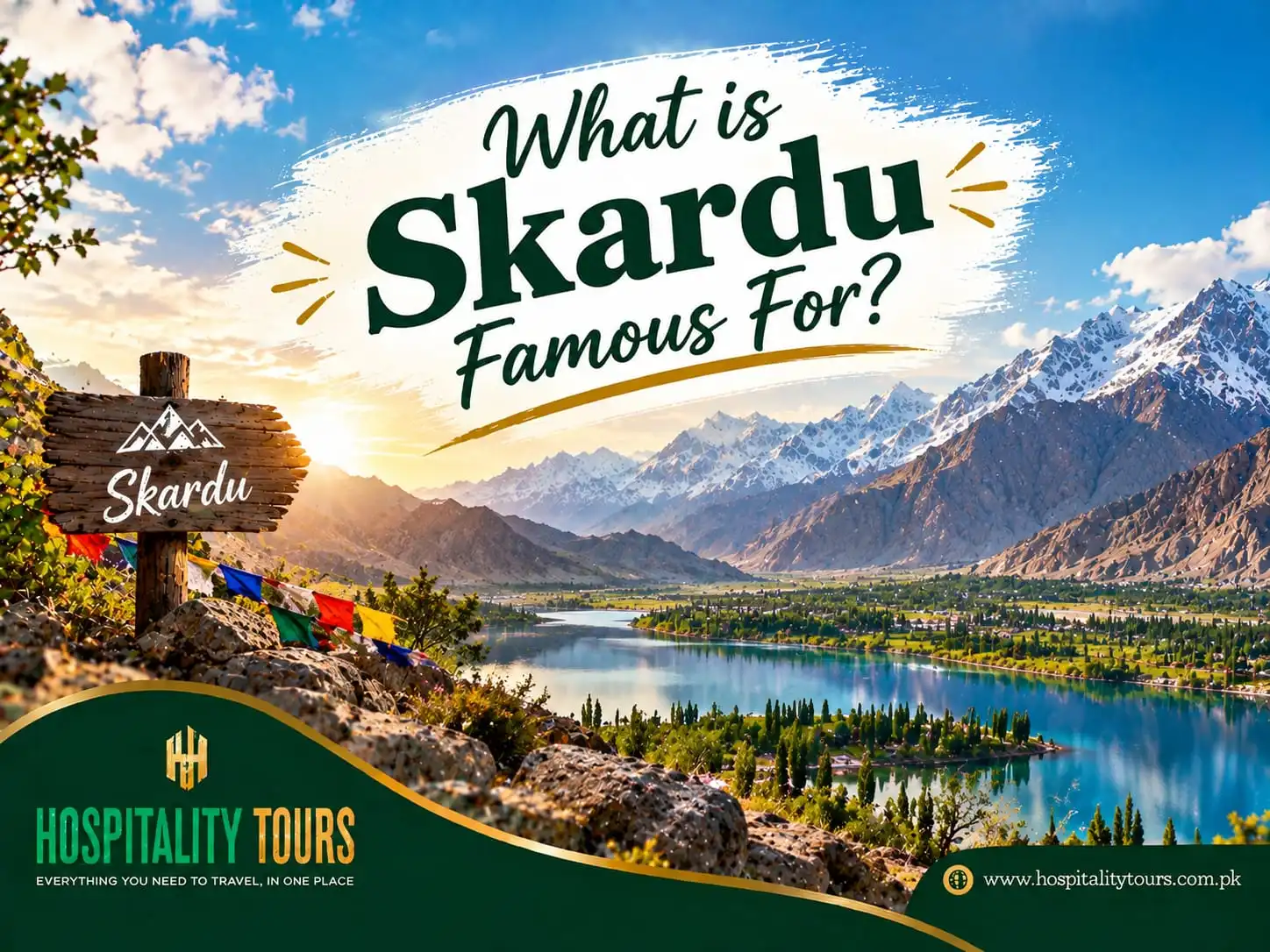
What is Skardu famous for?
Mostly K2. K2 is the second-highest mountain in the world and can be found in the Karakoram mountain range. This is where all of the expeditions have their base and where loads of supplies for the expeditions are transported. This is the short answer, but there is more.
The Baltoro Glacier, Deosai Plains, Skardu's cold desert, gemstone mines, apricots, a scenic flight, and exotic Balti culture all deserve their own honorable mentions.
K2 and the Karakoram Expeditions
Of the world's top five peaks, K2 comes in at 8,611m and is found in the Baltoro Muztagh subrange of the Karakoram. Only Everest is taller. K2 is more of a challenge than Everest, and the first successful ascent of it was on July 31, 1954, by an Italian expedition. Since then, there have been dozens of attempts by various countries to climb it, and they all stop through Skardu. A climate of anticipation descends on the bazaar in the months of July and August as all expedition loads are transported to the hotel gates where they are then negotiated by the porters.
The first-ever winter ascent of K2 occurred on January 16, 2021, by a ten-member team of Nepali climbers. The expedition captured the world's attention for a short time as mountain enthusiasts everywhere looked towards Skardu.
For trekkers without a climbing background, K2 Base Camp can be reached on a six- to seven-day supported trek beginning from Askole, which is about three hours away from Skardu by jeep. Concordia, from where K2 becomes visible, is situated at around 4,691 meters.
The Karakoram range and the Baltoro glacier
The sixty-two-kilometer-long Baltoro glacier flows from its snout near Askole towards Concordia, where K2 becomes visible at the junction. It passes some of the most extreme peaks on Earth, like the Trango Towers, Broad Peak, Gasherbrum I, Gasherbrum II, and Mitre Peak, among others.
The Baltoro Glacier is one of the longest classic treks in the world. In order to do Baltoro, one needs a license to trek, a guide, a cook, and camping equipment suitable for high altitudes. None of these come together at the last minute in Islamabad. For all the logistics, one must go to Skardu.
Deosai, the second highest plateau in the world
For many, Deosai defines Skardu. It sits above 4,114 meters, with grasslands, wildflowers, and streams, and is snow-covered for much of the year. It's a national park and home to the Himalayan brown bear. Sheosar Lake is at a similar elevation and sits in the middle.
Being the second-highest plateau on the planet is a title travel writing loves to bestow on the highest ‘flat’ places. For Deosai, it is true, given the many other sources that corroborate this. From the ridge of Sheosar Lake, it is possible to see the Earth’s curve.
Deosai is open from late June to late September and is accessible via the Skardu-Satpara Lake route.
Katpana Cold Desert
Katpana Cold Desert is an area of sand dunes that sit at around 2,200 meters behind the Karakoram range and near the airport, which is located on completely flat ground. In the winter, the dunes are completely covered in snow. Due to the altitude the desert haze disappears at night allowing for incredible views of the Milky Way.
Calling it a cold desert is climatologically accurate. The area has minimal precipitation and sand dunes. In January, the temperatures are below freezing. As much as this is climatologically accurate, it is highly unexpected to find a cold desert next to a high-altitude city in the mountains.
The gemstone mines
Baltistan and the wider Karakoram have been producing gemstones for centuries, and Skardu bazaar has the stones closer to the source than anywhere else in Pakistan. Aquamarine, pink tourmaline, garnets and other minerals come out of the mine workings in the mountains above the valley.
The trade is real, and so is the variation in quality. A stone sold as gem grade and priced accordingly may or may not be gem grade, and the only way to know is a laboratory test. Reputable dealers exist, and so do the other kind. Buy with the knowledge that you are making an aesthetic decision in imperfect information, not an investment.
The mines themselves, particularly the Shigar area and the valleys around Khaplu, have attracted mineralogists and collectors for decades.
Apricots and dried fruit
Baltistan grows apricots at altitude, and Skardu's apricots have a reputation across Pakistan that apricots from the plains do not. The cold nights and dry air concentrate the flavour in a way that warm-climate fruit doesn’t develop.
By July, the rooftops in Shigar, Khaplu and Skardu Valleys are tiled with drying apricots. Most of the visitors take these dried apricots along with apricot kernel oil from the dried seeds. The products include mulberries and walnuts.
Skardu has many quiet, yet pretty, scenes that are often unappreciated. These scenes occur every year without a show and provide a reason to come for a particular month. One of those is the sight of a family's roof completely orange in July.
Kharpocho Fort and Baltistan’s History
In the late 16th century, Ali Sher Khan Anchan of the Maqpon dynasty built the fort of Kharpocho on a rock above the Indus-Shigar confluence, making it the main tourist destination of the district. The Maqpon dynasty governed Baltistan from Skardu and stretched its control to Ladakh and Chitral.
Shigar Fort is thirty km away and was built in the 17th century; while it was restored by Aga Khan Trust for Culture, it has now been converted into a Heritage hotel managed by Serena Hotels. Khaplu Palace, a hundred km east, is mid-19th century and restored by the same trust, also managed by Serena Hotels.
These three buildings serve the three centuries of architecture of Balti court life and have survived due to conservation efforts.
Balti Language and Culture
Balti is a Tibetic language. It has more similarities to Classical Tibetan than the languages along the Pakistani plains. For many centuries, this language was written in a Tibetan-derived script. However, it was replaced by an Arabic-based script after the Islamization of the area. Currently, Balti lacks any official standing and is not taught in schools. However, almost the whole Baltistan region considers Balti as their first language.
The fact that Balti exists today is a testament to a great cultural achievement. During the Dogra occupation, as well as later during the period of Pakistani administration, and during the subsequent decades of tourism and contact with the outside world, this language has survived. Linguists regard it as one of the more archaic Tibetic languages and note that it possesses elements of Old Tibetan.
The food of Balti also departs from the mainland of Pakistan. During peak seasons, Balti food can be found in restaurants, but the best food is to be found in the homes, which run on apricots, walnut oil and meat preserved by drying. It is truly an independent cuisine, and the term 'balti' that is used in the UK to describe a style of curry has no relation to Balti food whatsoever.
The flight
The Islamabad to Skardu flight is one of the more unique air trips you can take. Rather than traveling above a mountain range, you travel through a corridor between mountain ranges. For most of the flight, you are at the same level as the mountain ridges. On one side of the plane, you can see the majestic Nanga Parbat, while at other times, weather permits a view of the Northwest Frontier Province. The total flight time is around an hour.
Skardu Airport may be the only way to get to the mountain peaks of the Karakoram. However, it has one of the most unpredictable flight patterns in the country. Visual approaches mean the aircraft cancels flights when clouds cover the valley. It can happen randomly, but it especially occurs in the winter. One less-than-sensible option is to take the flight to experience the beauty, but the recommended option is to take the sensible alternative, which is to take the road.
One of a kind location
The Pakistani town of Skardu is often called the gateway to the Karakoram. While the name definitely has been overused, it still fits. The main role Skardu plays is the starting point for almost anything that enters the Pakistani highlands of Karakoram. Most of the logistics, permits, outfitter services, and the support/porter community are located in Skardu.
Things to keep in mind
Confirm that Deosai is being maintained and accessible. The road to Satpara typically closes with snow by late September and opens again by late June.
Permits and time
A permit is also required for the Baltoro Kund trek. How far in advance you provide notice affects whether you’re able to obtain the permit. Some permits have short processing times, so make sure you’re allowed to take this last-minute trek.
While flying into Skardu, keep a road backup. Most flights into Skardu are subject to visual approach cancellation. It should not be too much of a surprise.
There are no ATMs along any of the routes to Shigar, Khaplu, Deosai or Manthokha. Cash is advised.
Book Shigar and Khaplu heritage hotels way in advance because peak season tends to run out of rooms.
Where can I go in Skardu? Skardu has many sightseeing locations like the K2 base, Baltoro Glacier, Deosai Plains, and the Baltoro Khatima Glacier. Ziarat is also known for its gemstone trading.
What should I know before visiting Skardu? The Balti language is spoken predominantly, with Urdu and English also being used.
Do the gems that I buy from Skardu gemstone mines actually come from there? The mines exist and produce aquamarine, tourmaline, and garnets. Quality and grading vary significantly. Buy the gems from a reputable dealer since most of the mines are privately owned.
When is the first recorded winter ascent of K2? On January 16, 2021, it was done by a team of 10 climbers from Nepal on what is now the last of the world’s 8,000-meter peaks to be ascended in winter.
What makes Skardu apricots special? The dry air and high altitude concentrate the flavor, and they are quite unlike regular apricots. What most visitors bring home is either dried apricots or apricot kernels and oil.
Come see for yourself.
All the things Skardu is known for are different in reality than in the description. Concordia from above the Baltoro is not a photograph. Altitude figures cannot describe Deosai early in the morning. We will facilitate you with the plan, permits, hotels, and jeeps on your chosen date and itinerary, and provide a comprehensive quote based on what you wish to achieve, with everything confirmed.
WhatsApp: +92 341 111 3777
Email: info@hospitalitytours.com
Head office: Office No. 2 & 3, Ground Floor, Parish Rose Plaza, Opposite NUST Gate 4, Sector H-13, Islamabad