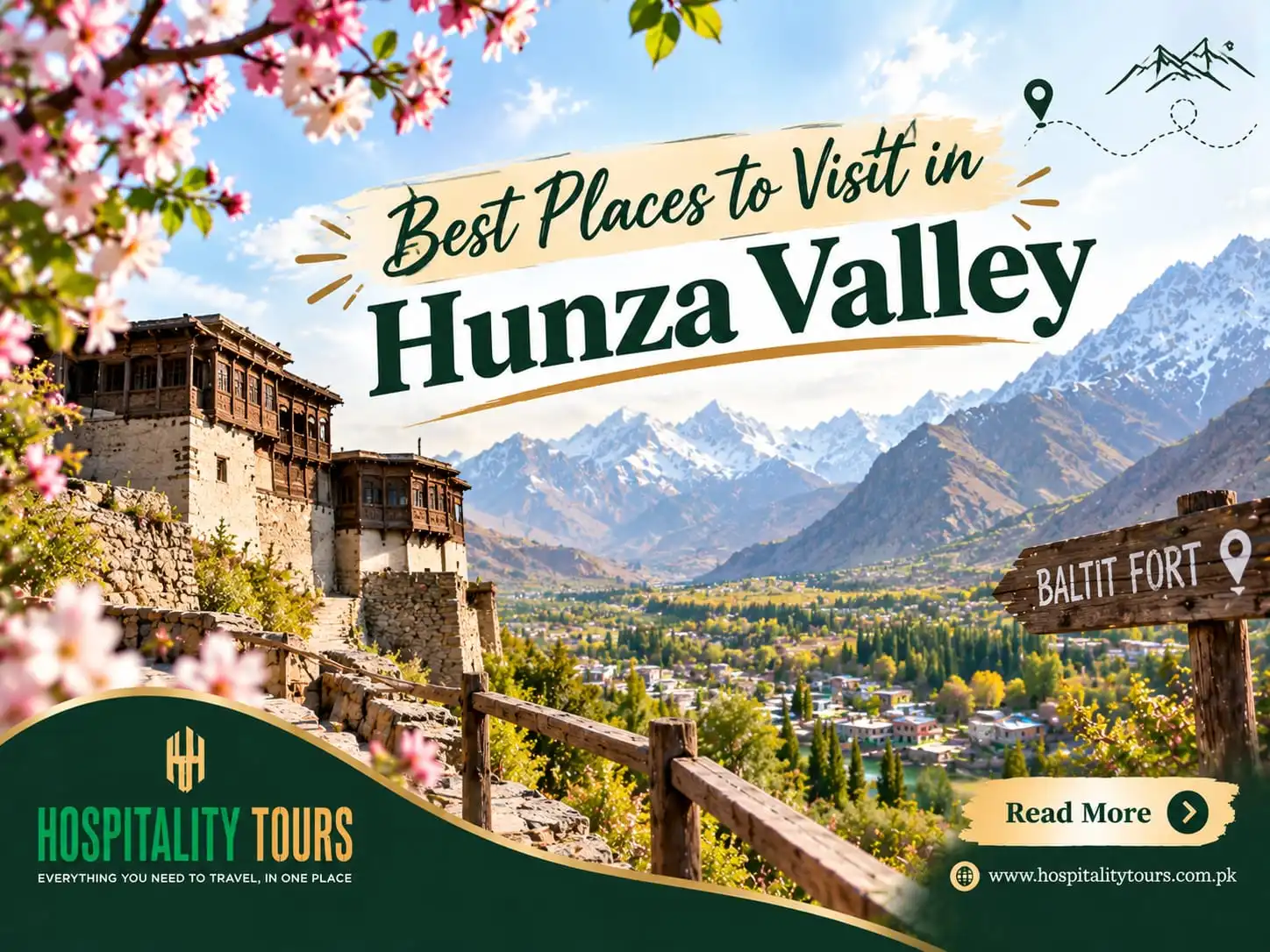
Best Places to Visit in Hunza Valley
Hunza is not a single destination on a northern circuit. It extends for over 100 kms along the Karakoram Highway, from the farming areas of the lower valley to the Chinese border at Khunjerab, in three regions that feel like distinct areas.
Lower Hunza includes Aliabad and Ganish, the older settlements, and where the valley sprawls. Central Hunza is where most travelers are, Karimabad, with the forts and terraces. The region of Upper Hunza, Gojal, begins at Attabad Lake. It continues to Passu and Sost and to the border with Gulmit, with visiting side valleys of Shimshal and Chapursan where almost no one visits.
Crossing the river is Nagar, another separate district with its own peaks and glaciers.
Here are some recommendations for each portion of the valley and how long you should plan to spend in total in the valley.
Karimabad and Baltit Fort
Karimabad looks onto the Hunza River from its terrace. Behind and across the valley are Rakaposhi at 7,788 meters and Ultar Sar. This location is the heart of everything: hotels, the bazaar, walking paths, and both forts.
Baltit Fort resides at the top of the village at the moraine of the Ultar glacier. The Mirs of Hunza held the fort for over seven hundred years and left it in the 1940s. The Aga Khan Trust for Culture restored the fort from 1990 to 1996. They won a UNESCO Asia-Pacific conservation award for their work. The roof of the fort gives you a view of the entire valley, which you can appreciate while standing on the ground. It runs as a museum now. It’s recommended that you budget one hour there with a guide. It takes longer if you enjoy old buildings. The walk up through the old lanes from the bazaar is part of the visit.
Altit Fort is twenty minutes below Karimabad and about four hundred years older than Baltit. The original rulers of the area built it. One of the family rifts put them at odds, and the capital was moved up the hill. There was a significant amount of Buddhist and Tibetan influence on the wood work that happened before Islam reached the valley.
Completion of the restoration was in 2010 and the following year it received the UNESCO Asia-Pacific Award of Distinction. The garden below it has a café and a craft workshop run by the local women as well. (Note: Altit is a more tranquil site than Baltit) If you have time for only one fort, take Altit for atmosphere and Baltit for the view.
Ganish village
Ganish village is the oldest settlement in Hunza and is located on a main road below Karimabad. Most travelers speed by it. The village consists of a central courtyard and has four mosques made of wood surrounding it. The village also has multiple watchtowers, a pond, and lanes that have remained the same structure over the years. The conservation project done at Ganish Village has earned UNESCO’s Asia-Pacific awards twice. If you want to see a nice example of village conservation projects, look no further than Ganish Village.
The Sacred Rocks of Hunza
The Sacred Rocks of Hunza can be found just off the Karakoram Highway and are known as the Haldeikish rocks. The Silk Road cut through this valley, and traders and pilgrims who passed through this way left their mark by carving inscriptions, names, and ibex figures into the rocks beginning in the first millennium. The Sacred Rocks of Hunza act as a nexus for history and trade, as travelers and pilgrims alike left their marks along the Silk Road. At these rocks, you are essentially looking at a guest book carved into the rocks 2,000 years ago.
Duikar and The Eagle's Nest
Duikar means "snow" and refers to the mountain that resides just above Karimabad and is the highest peak offering sunrise views of the entire valley. Duikar offers views of some of the most famous and picturesque peaks in the region: Rakaposhi, Diran, Ultar Sar, and Lady Finger.
The road that gets you there is about an hour's drive. Be sure to plan an overnight stay, as it is better to go there in the morning to catch the sunrise. The views are best about an hour after sunrise and begin to dissipate.
Attabad Lake
Attabad Lake came into being in January of 2010 when the Karakoram Highway was obstructed due to the flooding of nearby villages by the landslide dam formation across the Hunza River. The Lake is now 21 km long and reaches depths of over 100 meters. The glacial silt in the Lake is meltwater and is what is responsible for the Lake’s turquoise color.
There are boats, jet skis, and tunnels that move you around the highway. There are also fancy resorts. You can see the best colors around sunrise and sunset in this area, which is perfect for photographers. What you see is beautiful, but it's also someone's orchard!
Gulmit has quieter views than some of the more touristy places, with a small museum and lake views, and is easier to relax and explore with its peaceful atmosphere.
Hundreds of articles have mentioned the Hussaini suspension bridge, as it is unfinished and considered to be dangerous. Don't let that stop you; it's not as dangerous as it appears and is not recommended for those who do not enjoy heights.
The Passu Cones are the mountains known as Tupopdan at 6,106 meters. There is a reason this is the most photographed area in Pakistan, as it is beautiful.
Passu has two glaciers, and several tours are offered to walk on the glaciers safely, as people do not know how to navigate the dangerous areas.
#Borith Lake
There is a rough side road from Ghulkin that leads to Borith Lake. Shallow and calm, Borith is peaceful. It is a nice stop for migratory birds a much-needed pause from highway traffic. The Borith walk is an easy, wonderful hike to Passu Glacier. It is hands down the best.
Sost and Khunjerab Pass
Sost is the last stop before China. The dry port and traffic create a border "town" with little to no interest to travelers, but it is the only option for the early mountain pass run.
Khunjerab Pass at 4,693 meters is the world's highest paved international border crossing located within the Khunjerab National Park. Ibex and marmots call the National Park home.
Slow ascent. From around 2,500 meters in Hunza, it is an uphill struggle to nearly 4,700 meters. The air at the top is thin, and walking is a challenge.
Shimshal Valley
Shimshal is the highest permanently inhabited valley at around 3,100 meters. Via an incredible journey of two decades, the building of the jeep road from the main road made the once three day trek to access the valley much easier. However it is still a slow and dangerous drive.
There's a camping village. It's produced a lot of mountaineers from Pakistan, high summer pastures, and lots of trekking land that isn't very visited. This trip takes at least 2 nights. You need a driver with experience taking that particular road.
Chapursan Valley
This runs west from near Sost towards the Afghan Wakhan corridor, ending at the shrine of Baba Ghundi. It is very remote and the farthest you can get from a tour bus. Take a guide and expect basic accommodations.
Across the river in Nagar
Nagar is a separate district but is directly across from Hunza and any itinerary worth doing will cross over there.
The Rakaposhi viewpoint at Ghulmet on the main road puts you under the face of this 7,788 meter peak with a café, and serves tea in this amazing view.
Minapin is the beginning point of the Rakaposhi Base Camp trek. This is a 2 day trek and presents a real opportunity to do a part of the Karakoram trekking route.
Hoper has a dark and debris-covered glacier that has a lot of change and activity. This trek ends at Rush Lake which is a trek and one of the highest Alpine lakes.
Peak seasons
The Hunza region is famous for the blossom that happens in the March and April time frame. This is when the apricot and cherry trees bloom and the rest of the rock and rubble is bare.
Summer time (June-August) has all the important sites open with a lot of people because it is high season andprices are at their highest.
Autumn, in particular October, has some of the best light of the year and poplar trees begin to turn a beautiful gold at the end of October.
Winter brings snow, frozen waterfalls, empty forts, and crisp air. The route over the Karakoram Highway remains open to Sost, but it becomes more of a question of where you’ll stay and where will have heating along the way.
How many nights you actually need in Hunza
Many people make the mistake of thinking 2 nights is enough, but this is nearly always the result of how much time people think the drive from Islamabad will take.
3 nights is the bare minimum: one at Karimbad and the forts, one at Attabad and Gojal, one at Khunjerab Pass.
5 nights lets you actually stay for the night in Gojal, take a walk to the glacier, and see Duikar with time to spare over breakfast.
7 nights or more allows access to Shimshal, Chapursan, or treks to Rakaposhi Base Camp on the Nagar side.
Things worth knowing
No permits are needed for any of the sites listed. Foreign nationals are stopped at a few checkpoints along the highway and there is a small entrance fee for Khunjerab National Park.
At certain points along the route, mobile coverage is limited. Make sure to let friends and family back home know exactly where you are going to be and for how long you will be out of contact. There are cash only transactions along the route so make sure you have enough cash and don’t rely on the ATMs in Aliabad and Gilgit because they aren’t reliable.
Load shedding happens often, so never rely on assumptions, always double check. Distances are deceiving. For reaching the Borith, Hoper and Shimshal side roads, you will need a 4x4 and a confident driver.
Three thousand meters and altitude sickness are real. Allow time for your body to acclimatize to the altitude by drinking plenty of water and going slowly. Hunza is a good step before tackling Khunjerab.
What to check and what to avoid
Bargain for boat and jet ski rides at Attabad. Wear your life jacket, the water is glacier cold.
When calling to book your room, ask if your room has working heat for the month that you will be there.
Do not attempt Shimshal, Hoper or Chapursan in saloon cars and do not drive mountain roads at night.
Do your best to avoid the 14th of Aug or Eid around here. Karimabad has terrible traffic jams and worse for your wallet accommodation and food prices are twice what they usually are.
Asking permission is wise to avoid offending anybody. Especially the women, Hunza is relaxed for the region but that does not mean consent.
You should not plan on having a quick trip back across the mountains, Nok Airplane tickets out are canceled more frequently for weather and road closures. Plan on having an extra day to be safe.
Plan your trip to Hunza with us
We will create a complete travel itinerary for you, based on travel dates, number of travelers, and days of travel. The itinerary will include overnight stays in hotels in Karimabad or on the lake, transport with drivers who can navigate the side roads, licensed local guides, and timing to ensure one can see Duikar at sunrise instead of in the middle of the day. Clients will also receive a complete travel itinerary and price overview prior to any bookings. Additionally, clients will have a contact throughout the travel itinerary for any needs or assistance.
WhatsApp: +92 341 111 3777
Email: info@hospitalitytours.com
Head office: Office No. 2 & 3, Ground Floor, Parish Rose Plaza, Opposite NUST Gate 4, Sector H-13, Islamabad