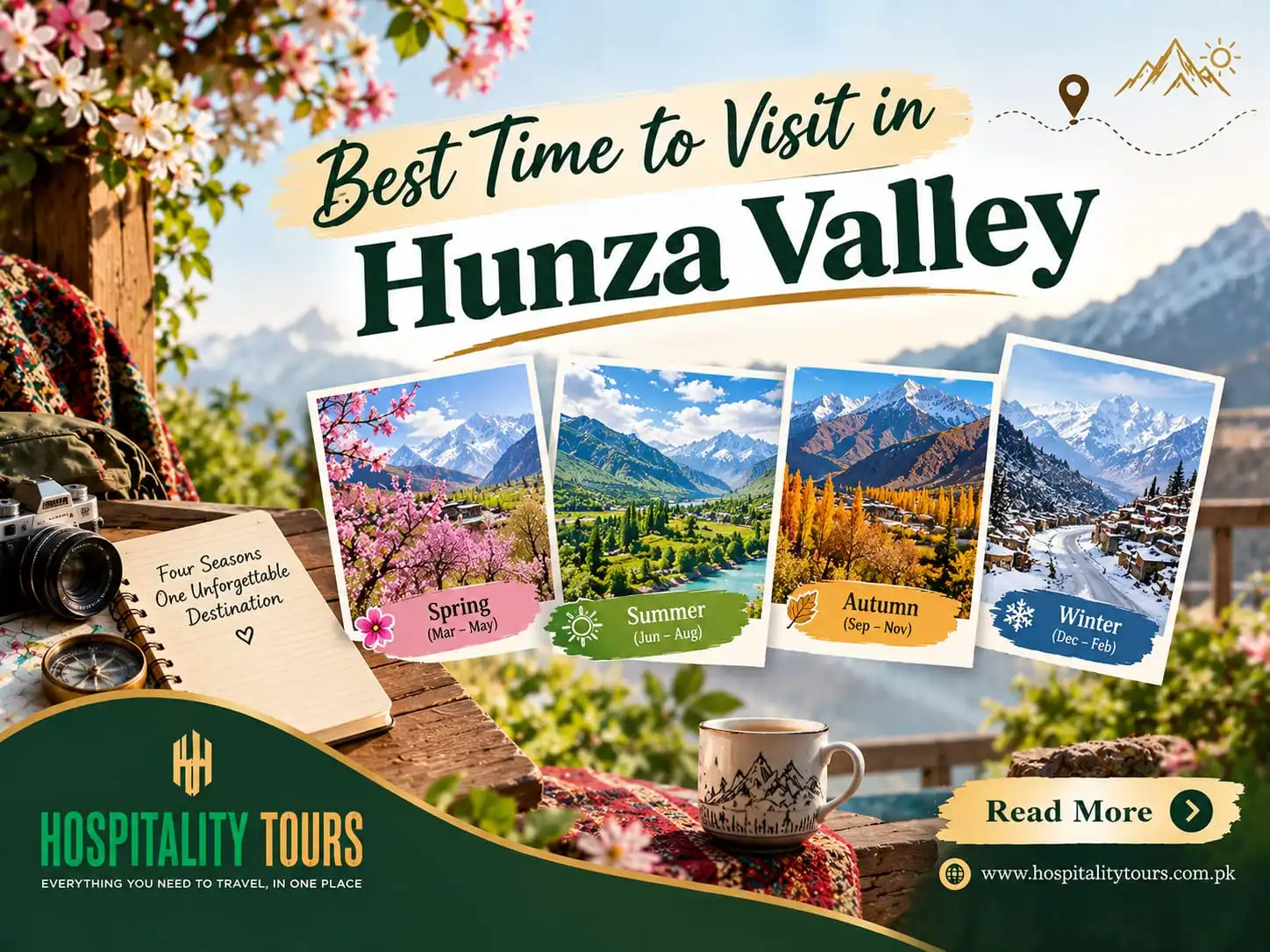
Best Time to Visit Hunza Valley
To cut a long answer short, late September and early October. Less clear skies, more sharpness to the glacial peaks, lots of gold poplar leaves, and the usual crowds? Gone!
If you want blossoms, come the first half of April. For Khunjerab Pass and high treks, come June to early September. For snow, come January.
Hunza is Accessible every month, which is rare in the North. This helps focus on the actual end goal.
Why Hunza has its own Calendar
Most of Gilgit-Baltistan is a desert in a rain shadow, and Hunza is no exception. The monsoon that drowns Punjab in July stops at the Himalayan Wall, so the Valley gets very little rain, and most of its precipitation is in the form of winter snow.
The other major factor of the Calendar is that the Karakoram Highway remains open all the way to Sost all year round, which is unusual for Babusar, Deosai and Shandur, as they close for several months at a time. Hunza doesn't hide itself behind snow the way Naran or Astore does. Hotels close, side roads close, and Khunjerab closes. The Valley remains open.
Karimabad is at about 2500 meters, and so is fairly cold at night at any time of the year, but is fairly comfortable during the afternoons most of the year.
Sometime between late March and mid-April
This is your brief window to visit, and people fly in to see it. Apricot and cherry orchards cover the terraces and start to bloom. The Valley is coated with white and pink petals against the bare rock and snow-capped peaks.
The timing also fluctuates with elevation. The lower parts of Hunza (like Ganish and Aliabad) start to bloom first, and then the rest (including Karimabad) follows. Last to bloom are the villages up in Gojal (Gulmit and Passu). If you are particular about timing, you should consider a longer trip of a week, instead of just a weekend.
You also can't be too particular about the timing, because it fluctuates every year. A cooler February will move blooming time later to mid-April, while a warmer February will start blooming earlier. Of course, no one can give you an exact date, and no operators can tell you a date. They're likely guessing as well.
There is also the fact that it is still winter up there, so the high treks and the side valleys will be inaccessible. Most rooms in Karimabad for these weeks sell out because of the great views.
May is an underrated month.
After the blossoming season, Hunza starts to green up, and most seem to miss it. The lower valleys start to open, and Khunjerab reopens as well after the closure of winter. Domestic tourists and the high season haven't started, and the weather is just about perfect. This puts May as a great time for your first visit with no real destination in mind.
The entire Valley runs its business during the summer months, with all the highways and back roads being operational, meaning treks to Ultar Meadow, Patundas, Rush Lake, and Rakaposhi Base Camp can be enjoyed during the season. Additionally, the side roads to Shimshal, Chapursan, Borith and Hoper become accessible too.
July means apricot harvests. Observe, if you will, thousands of roofs in the Valley adorned with fruits that will be dried in the sun. It is perhaps one of the more photogenic, and more importantly, mundane things about Hunza, from which photographers prefer to shoot in this month as opposed to the blossom, for obvious reasons.
The heavy flow of tourists means high prices and even longer waiting times. Shops close; the highest influx of tourists can be noticed during the holidays and the weekends. This means double prices and significant congestion along the road through the markets.
This access issue remains on the other side of the Valley. Hunza receives very little rain during the monsoons, but the rain roads across Kohistan, which is the landslide region of the country, are particularly troublesome during the rains. This stretch of the Karakoram Highway closes numerous times during the summer and was especially bad in recent summers. Allow a day or two extra while planning your travel.
September and early October are the very best weeks
Rain is curtained, dust dissipates and mountain views blossom. Rakaposhi, Diran and Ultar hold enthralling detail from first light to last, which is not the case in summer haze.
Most roads are open, and the main domestic tourist activity has returned to working and studying, along with decreased hotel prices. The trekking season has several weeks left, and passes are still open.
If you have freedom for any two weeks in the year for Hunza, take early September.
Gold: mid-October to early November
Poplars and apricot trees transform the second half of October to copper and yellow along every irrigation canal. It is the second-best photography window, and is even less busy than the blossoms.
Nights freeze quickly. Khunjerab starts closing with end-of-season snow, and seasonal hotels begin to close. The selection of open rooms continues to narrow as November progresses. Rates are the lowest of the year.
Snow and total silence:
December to February
Winter is a true destination in Hunza. Snow settles on Baltit Fort and rooftops, ice forms on the shallow arms of Attabad, and frozen waterfalls line the highway. An afternoon in Karimabad can be enjoyed without meeting a single traveler.
The air is best this year now that winter is approaching. The highway stays clear to Sost, but snow often blocks the side roads to Shimshal, Chapursan, Borith and Khunjerab.
Khunjerab is currently closed. Many hotels close, and others only provide heating for a short time, so the place to stay is the main concern. The days are short, so you should plan to walk instead of driving. There are more flight cancellations to Gilgit during winter compared to other seasons, which means taking the road is the best option over being stuck on a canceled flight.
January- February: Very cold air with lots of snow on the forts. This time of year is good if you want to escape the crowds.
March: We start to see snow melt on the lower forts, and start to have some unsettled weather, first signs of spring of the year.
April: The lower valleys start to green up during the first part of the month. Khunjerab opens during this month.
May: A perfect month because there's a lot of green and overall nice weather.
June: Everything opens for the season, including the start of trekking. Crowds and rates begin to increase.
July: Apricot harvesting month, rate increase, and the start of monsoons.
August: The start of long school breaks and peak tourist season. The same risks of July also apply.
September: The best overall month. Crowds begin to decrease, and weather starts to settle. Rates begin to drop.
October: Autumn weather begins, and the rates continue to drop.
November. Shoulder season. Quiet and cheap, with fewer hotels open and short days.
December. Snow returns and winter officially begins, and the Valley is empty.
Based On Trip Desired
Photography. Clear and snowy weather is best in January. Blossoms are best in October. If you want to photograph the Co. Siskiyou Mountains sharply, September is the month.
Honeymoon. Weather is nice in late April, May and September. Availability is good. Crowds are nonexistent.
Families. May and early June are good. There aren't any closures at altitude.
Treks. Late June and early July. Safe weather is the best time to tackle higher, more dangerous routes.
Khunjerab Pass. Travel to the Pass is best during Late Spring and early Summer.
Budget Travel. November. The Valley is empty. Rates drop.
Corporate Travel. October and September. Your group will have little to no chance of missing travel days due to unpredictable monsoon weather.
Foreign Travelers. April and September will allow you to see the best of the Valley while allowing you to take a quick trip to Baltistan.
Based On Other Factors
Variation in Blossom. Flexible trips are best two weeks before and after the main blossom months.
Eid holidays: They move eleven days earlier every year and pack all the hotels. See the dates and plan accordingly.
School holidays and the 14 August weekend: Similar effect, fixed dates.
Hotel opening seasons: A hotel that is fantastic in July may be closed in December or open and not have heating.
Flight reliability: Gilgit and Skardu flights are cancelled due to clouds in any month and more frequently in winter.
Road works and closures on the Karakoram Highway. These happen with little notification, especially in Kohistan.
What to check and what to ask before you fix your dates
Ask your operator for their guess for blossom this year and their contingency plan for early or late blossom. A constructive answer will be a range and not a single date.
Ask whether Khunjerab is currently open and whether the answer is this week vs. last season.
Ask hotels whether they are open in your requested month and regardless of whether the heating is on, as two different questions.
Ask what occurs when the street closes on the approach. Who reschedules, who pays for the additional night, and the amount of notification you are expected to provide.
Plan to have at least one spare day in a seven-day trip and two extra spare days in a longer trip, basically in the entire months of June-September.
Do not book a same-day connection out of Islamabad on the day you come off the highway.
Skip the Eid and Independence Day weekends unless you like crowds.
Frequently asked
Hunza in September? Clear skies. Open roads. Thinner crowds.
Hunza for blossoms? Early April.
Hunza in winter? The Karakoram Highway stays open to Sost. The Valley in snow is a unique trip and a beautiful one. Be sure your hotel has heat and is open for the season.
Khunjerab Pass? Snow closes it in the winter. The spring opening date is a moving target, so be sure to check a week or so before traveling.
How much time is enough for a trip to Hunza? Three nights at a bare minimum; five days is good; seven or more for trekking and going to Shimshal.
Does the monsoon affect Hunza? It does not affect the dry Valley. The monsoon season, lasting from July to August, poses a threat to the Kohistan road section, but the Valley itself is safe.
When is Hunza the least expensive? November, with the months on either side of the peak seasons of April and October.
What travel dates do you prefer? Please tell us when you can travel to get a quote for your ideal trip. Whether you are planning your trip to experience mountain blossoms, autumn colors, a panoramic view, a leisurely week, or a hike, send us your travel dates and desired trip details. We will be transparent with you about what you can expect for your travel dates and will let you know if we find dates that are more suitable for your trip. We will also provide you with hotel and transport quotes, as well as guide bookings and an overall trip quote for your approval before we make any bookings for you.
WhatsApp: +92 341 111 3777
Email: info@hospitalitytours.com
Head office: Office No. 2 & 3, Ground Floor, Parish Rose Plaza, Opposite NUST Gate 4, Sector H-13, Islamabad