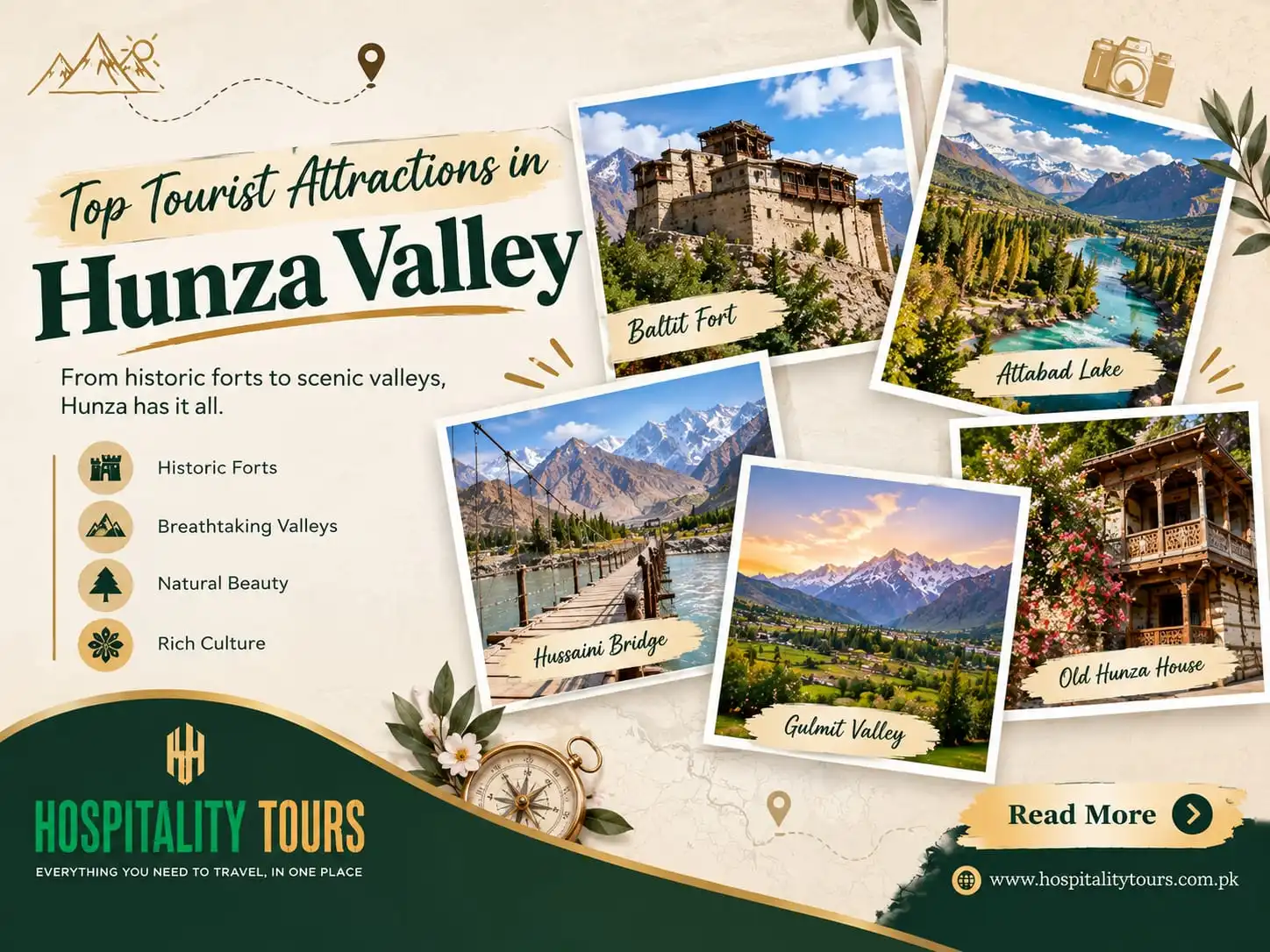
Tourist attractions in Hunza Valley
Below you'll see the altitude sketches of the tourist attractions of the Hunza Valley. For your trip, time constraints will be the most important consideration, as the distances are short, but the time needed to travel them is much greater.
These sketches are organized by the location of the attractions in the valley, with the distance in kilometers from Karimabad and an estimated time it takes to get there.
Central Hunza
Baltit Fort
The Baltit Fort, an important landmark, is located at the top of Karimabad, along the moraine of the Ultar Glacier. This was the seat of the Mirs of Hunza for over 700 years before they moved, and it was restored between 1990 and 1996 by the Aga Khan Trust for Culture. This restoration was recognized by the UNESCO Asia-Pacific Conservation Award.
Tickets have to be bought for entrance to the Fort, and a guided tour is offered which takes you through the rooms and on to the roof. Allow an hour, and maybe more if the guides are interesting. The walk up from the Bazaar along the old mountain paths is part of the experience.
Altitude sketches of tourist attractions in the Hunza Valley
For the convenience of planning your trip, below is a series of sketches showing the altitude of some of the tourist destinations along the Hunza Valley. Constraints due to the best way to estimate time rather than distance would be the most important consideration, as distances are very short. Still, the time needed to cover them would be significantly greater.
These sketches are organized by the location of the attractions in the valley, showing the distance in km from Karimabad and an estimated time to get there.
Central Hunza
Baltit Fort
The Baltit Fort is a landmark of the valley, which is located at the top, on the moraine of the Ultar Glacier. It was the seat of the Mirs of Hunza for more than seven hundred years, and was abandoned in the 1940s. It was restored between 1990 and 1996 by the Aga Khan Trust for Culture. This restoration was recognized by the UNESCO Asia-Pacific Conservation Award.
Ticketing and guided tours are available for viewing the structures and the roof. It takes a minimum of an hour, and more if the guides are interesting. The walk up from the Bazaar along the old mountain paths is part of the experience.
Altit Fort and the Royal Garden
Roughly twenty minutes from Karimabad, Altit was built about four hundred years before Baltit and was the original seat of the rulers. The woodcarvings within the Fort show a strong influence of Buddhism as well as the centuries before Islam reached the area. Restoration was completed in 2010, and the following year the Fort was awarded the UNESCO Asia-Pacific Award of Distinction.
There is also a garden and a café. There is also a women's social enterprise craft work center on the site that produces woodwork, textiles, and jewelry. It is well worth your time to give this site twenty minutes.
An hour and a half total should cover the Fort, garden, and workshops.
Ganish village and the Sacred Rocks
Ganish is the oldest settlement in Hunza, on the highway below Karimabad, and most people drive past without stopping. There are historic wooden mosques and a pond, as well as a conservation effort that won two UNESCO Asia-Pacific awards.
Just a bit further along the highway are the Haldeikish rocks, the Sacred Rocks of Hunza, where travellers from the Silk Road left their names, ibex depictions, and inscriptions from the first millennium.
This is a good ten-minute drive from Karimabad and should take a total of thirty minutes from the village and about twenty minutes to the rocks.
Duikar and the Eagle's Nest Viewpoint
The sunrise viewpoint of Hunza, on Karimabad's ridge. Here you can enjoy the sweeping views of the spectacular peaks of Rakaposhi, Diran, and Ultar Sar, along with Lady Finger and the terraced villages below.
The steep gravel road that heads up to the ridge takes about 30 to 40 minutes. Enjoy the stars! Go up before sunrise or stay there overnight. The best views of the stars from one of the darkest skies in the country are about thirty minutes before sunrise.
Karimabad Bazaar
Check out caps, wool, walnuts, mulberries, apricots, apricot kernel oil, and embroidery. Start early and enjoy some walnut cake and tea from the best spot in the valley.
Watch out for the gemstone sellers.
Be careful; most that are offered along the highway as ruby, lapis or emerald aren’t what they are called, and there isn’t a way to test it on the spot.
Ultar Meadows
The best short hike from Karimabad, approximately half a day there and back. Steep and short, go if you're reasonably fit, and this hike does not require a permit. If you are not familiar with the trail, take a guide as there are a couple of spots that are not well marked.
Lower Hunza and Nagar side
Rakaposhi Viewpoint, Ghulmet
About 45 minutes below Karimabad on the highway, with cafés and a good view of the north face of Rakaposhi. Good place for a tea break.
Minapin and Rakaposhi Base Camp
Across the river in Nagar, Minapin is the starting point for a two-day hike to Rakaposhi Base Camp involving one night at a high camp. As far as serious hikes go, this is the easiest to get to in the region. It requires hiking boots and a guide.
Hoper Valley and Glacier
From Karimabad, it's an hour and a half drive on a less-than-ideal road to Hoper, where you can see a dark, debris-covered glacier that is visible to have moved each year. From here, it takes about four to five days to trek to Rush Lake, one of the highest alpine lakes in the world, at 4,694 meters.
Upper Hunza, or Gojal
Attabad Lake
This lake was formed in the first of many tunnels, 45 minutes past Karimabad, after a landslide dammed the Hunza River, flooded and buried villages and farmland, and submerged nineteen kilometers of the Karakoram Highway. The lake is 21 kilometers long and over 100 meters deep. The turquoise color is the result of glacial silt.
During the summer, jet skis and boats are available to rent. Hire a boat, decide on the price and duration, and make sure you wear the life jacket because the water is very, very cold.
Gulmit
This is the main town of Gojal, and is quieter than Karimabad. There are old houses, a women’s carpet weaving center and a small museum.
Ondra Poygah
The Gulmit community constructed a 1,655-step staircase by combining stone and mud as a path to move from the old polo grounds to the Ondra fort ruins above the village. This staircase is thought to be the longest staircase in the country. It took the Gulmit community about sixty days to complete.
About an hour of steady climbing, and you can enjoy the Gulmit village below, Attabad Lake, the Passu Cones, Shispar Peak and the Ghulkin Glacier. This is an excellent spot to visit during spring and fall.
Hussaini suspension bridge
This suspension bridge connects Hussaini village to Zarabad across the river. It is on every frightening bridges list that is published and appears to be somewhat flimsy. During the summer months, you can enjoy the views with a zip line.
You can expect good storytelling from your ten-minute trip.
Passu Cones
When you drive approximately 30 minutes north of Attabad on the highway, you will see steep peaks rising directly from the valley floor. This is one of the most photographed areas in Pakistan and will cost you nothing. The best time to photograph it is during the early morning.
Passu and Batura glaciers
Passu village is located between two glaciers. The Passu Glacier is easily seen from the road, and the longer Batura Glacier, one of the longest outside of the polar regions at 57 kilometers, can be viewed from the Passu village area.
Walking on the ice needs a guide who knows the glaciers and boots with grip. Looking at it from the moraine needs neither.
Borith Lake
A natural lake on the rough side road near Ghulkin that migratory birds visit in spring and autumn. The hike from Borith towards the Passu and Ghulkin glaciers is one of the easiest half-day hikes in Hunza. It is mostly flat, with ice in front of you the whole way.
Sost
The last town of Pakistan before China, built around the dry port and the border crossing. It is a place to stay for the night before the long and early drive to the border crossing rather than an attention-worthy destination on its own.
Khunjerab Pass and National Park
At 4,693 meters, it is the highest border crossing in the world, two hours from Sost in Khunjerab National Park. Along the way, you can see marmots and ibex dwelling on the slopes, and snow leopards live there but are never seen.
There is a fee to enter the park. The border crossing is closed in winter. Plan at least a day trip from Karimabad and go slowly since many people are overcome with the effects of the altitude gain.
The far valleys
Shimshal
The highest permanently settled valley of Hunza at about 3,100 meters, reached via an incredibly difficult and long jeep road which the community constructed themselves. It has produced an amazing percentage of Pakistan's mountaineers and receives very few visitors.
Three to four hours by jeep from the turning near Passu, on a road that needs a driver who has been there. Two nights make the journey worth it.
Chapursan
West of Sost up to the Baba Ghundi shrine in the Wakhan corridor of Afghanistan, beyond the tour groups, remote, with a sparse population, a Wakhi-speaking people: basic accommodation and a guide recommended.
How the attractions connect
With 2 hours from Gilgit to Karimabad, 45 minutes from Karimabad to Attabad, 30-40 minutes from Attabad to Passu, and another hour from Passu to Sost, the drive up to Khunjerab is around 2 hours.
Everything on the main road is easy, tarmacked road driving, but everything off it requires slow driving on rough roads (Duikar, Borith, Hoper, Shimshal, Chapursan) and a driver who knows the area.
Which attractions suit which visitor
Heritage and culture. Baltit, Altit, Ganish, Haldeikish, craft workshops, Gulmit.
Photography. Dukiar at sunrise, Passu Cones in the morning light, Attabad at sunrise or sunset, Ondra Pogah at sunrise, sunset, or autumn, Passu Glacier.
Walking. Commitment-free walks: Ultar Meadow, Borith to the glaciers, Ondra Pogah.
Trekking. Rakaposhi Base Camp, Patundas, Rush Lake, Shimshal Pass.
Families. The forts, Attabad Lake, Rakaposhi View Point, Karimabad Bazaar. Avoid high passes.
Corporate groups. Use a single hotel, stick to half-day trips, and add a Khunjerab drive day with no other activities to follow.
Things to know before you go
Check if the forts are open before you go. Winter and some public holidays mean that hours are reduced.
Agree the price and duration with the driver before you go in a boat, jet ski or jeep and ask for a receipt if you made a booking through the operator.
Carry cash with you. ATMs in Aliabad and Gilgit are very unreliable, and no one at the small sites, boatmen or craft shops takes cards.
Never attempt Borith, Hoper, Shimshal or Chapursan in a saloon car and never drive any mountain roads at night.
Have at least one night in Hunza before going to Khunjerab and take plenty of water with you.
Be sure to ask permission to take people's photographs, especially women, and be respectful of refusals.
Keep the sites clean and take your litter with you.
Answers to frequently asked questions.
How many places can you visit in three days? Forts, Ganish, Attabad, one Gojal walk and a visit to Khunjerab. That is three full nights with nothing left in reserve.
Do I need a permit? For the places mentioned on this list, no permit is required. Foreign visitors show their passport at checkpoints and pay the park fee at Khunjerab.
Are the forts open all the time? They both stay open through the year, but have shorter hours in winter. call before traveling in December through February.
Is Attabad Lake Natural? It was formed by a landslide that happened in 2010 while the spillway was being engineered.
Is Nagar part of Hunza? Although Nagar is a separate district across the river, Rakaposhi View Point, Minapin and Hoper are usually covered as part of the trip to Hunza.
What is the best time to visit these? Early April for the blossoms, late September and October for the clear air and autumn colors, and June to August for the treks and Khunjerab.
Plan the trip with us.
Let us know your dates, how many are traveling and how much time you have, and we will do the rest. We pair the best attractions to visit on the same day. We also suggest where to stay to avoid a long drive to your next destination. We arrange side roads that really need a jeep. You get the itinerary and full travel plan with accommodations booked, transport arranged, and tour guides confirmed, priced and confirmed before anything is booked.
WhatsApp: +92 341 111 3777
Email: info@hospitalitytours.com
Head office: Office No. 2 & 3, Ground Floor, Parish Rose Plaza, Opposite NUST Gate 4, Sector H-13, Islamabad